
What “Good Financial Health” Looks Like in a Business
Every founder wants growth. More customers. More revenue. More visibility. But here’s the truth most people don’t talk about: revenue alone doesn’t mean your business is in good financial health.
You can be making sales and still be struggling behind the scenes, running out of cash, overextending, or relying on guesswork instead of data.
Financial health is about stability, control, and clarity. It’s what allows a business to survive tough periods, invest confidently, and scale sustainably.
In this guide, we’ll break down what good financial health actually looks like without jargon and how you can measure it in your own business.
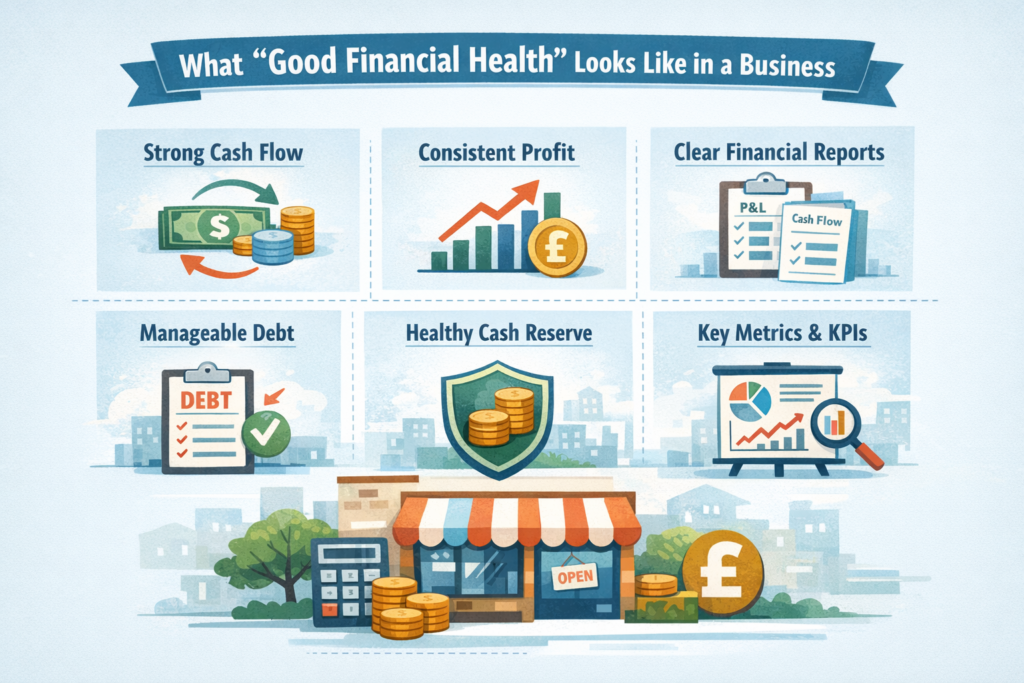
What Is Financial Health in a Business?
Financial health refers to how well your business manages its money, obligations, and future risks.
In simple terms, it answers three key questions:
- Do you have enough cash to operate?
- Are you making a profit?
- Can your business survive uncertainty?
If the answer to all three is yes, you’re likely in a strong financial position.
Financial Health Starts With Strong Cash Flow
Cash flow is the movement of money in and out of your business.
👉 Definition:
Cash flow = the net amount of cash coming in (sales, payments) minus cash going out (expenses, salaries, bills).
Signs of healthy cash flow:
- You can pay bills on time
- You’re not relying on debt to survive
- You have surplus cash at the end of each month
Many businesses fail not because they aren’t profitable but because they run out of cash.
Financial Health Means Consistent Profitability
Profit is what remains after all expenses are paid.
👉 Definition:
Profit = Revenue – Expenses
There are two key types:
- Gross profit: after direct costs
- Net profit: after all costs
What good financial health looks like here:
- Consistent monthly or quarterly profits
- Clear understanding of margins
- No surprise losses
A business with strong financial health doesn’t just generate revenue, it keeps a meaningful portion of it.
Financial Health Requires Clear Visibility of Financial Reports
You can’t manage what you can’t see.
👉 Definition:
Financial reports are structured documents that show how your business is performing financially.
The key ones include:
- Profit & Loss (P&L)
- Balance Sheet
- Cash Flow Statement
Healthy businesses:
- Review reports regularly (monthly at minimum)
- Understand what the numbers mean
- Use reports to make decisions—not just for compliance
Financial Health Depends on Managing Business Liabilities
👉 Definition:
Liabilities are what your business owes: loans, unpaid bills, taxes, etc.
Too much debt can weaken your financial health, even if revenue is strong.
Healthy signs:
- Debt is manageable and planned
- You’re not using loans to cover basic operations
- Repayments don’t strain your cash flow
Financial Health Includes a Strong Cash Reserve
A financially healthy business plans for uncertainty.
👉 Definition:
Cash reserve = money set aside to cover future risks or emergencies.
Best practice:
- Maintain at least 3–6 months of operating expenses
- Keep reserves separate from daily operating cash
This is what keeps your business stable during slow periods or unexpected costs.
Financial Health Improves With Predictable Revenue
Unpredictable income creates stress and risk.
Healthy businesses aim for:
- Recurring revenue
- Repeat customers
- Forecastable income streams
👉 Definition:
Revenue predictability means you can reasonably estimate future income based on past performance.
Financial Health Is About Controlling Costs, Not Just Cutting Them
Cost control doesn’t mean being cheap—it means being intentional.
Signs of strong cost control:
- Every expense has a clear purpose
- Regular review of subscriptions and overheads
- No unnecessary spending “leaks”
Healthy businesses invest but they invest wisely.
Financial Health Requires Accurate Financial Systems
Spreadsheets alone won’t cut it as you grow.
👉 Definition:
Financial systems are the tools and processes used to track, manage, and analyse financial data.
A business with good financial health has:
- Reliable accounting software
- Automated tracking of income and expenses
- Clear processes for invoicing and payments
This is where many small businesses fall behind, not because they lack revenue, but because they lack structure.
Financial Health Means Knowing Your Key Metrics
Healthy businesses track the right numbers consistently.
Key metrics include:
- Profit margins
- Burn rate
- Customer acquisition cost (CAC)
- Lifetime value (LTV)
👉 Definition:
Burn rate = how quickly your business is spending cash over a given period.
👉 To go deeper into the most important metrics, read the post on KPIs.
Knowing these numbers gives you control and confidence.
Financial Health Supports Better Decision-Making
When your finances are clear, your decisions improve.
You can:
- Hire with confidence
- Invest in growth
- Expand strategically
- Avoid unnecessary risks
Without financial health, decisions become reactive instead of strategic.
Common Signs Your Financial Health Needs Attention
Watch out for these warning signs:
- You don’t know your monthly profit
- You rely on overdrafts or credit regularly
- You avoid looking at your financial reports
- You’re constantly stressed about cash
These aren’t just operational issues, they’re signals your financial health needs work.
How to Improve Financial Health in Your Business
You don’t need to fix everything overnight. Start with these steps:
- Track your cash flow weekly
- Review financial reports monthly
- Build a simple budget
- Reduce unnecessary costs
- Create a cash reserve plan
- Implement proper financial systems
Consistency matters more than complexity.
How Tookand Helps Businesses Improve Financial Health
At Tookand, we help business owners move from financial guesswork to financial clarity.
We:
- Set up structured financial systems
- Simplify reporting and dashboards
- Help you understand your numbers
- Support better financial decision-making
Good financial health isn’t just about surviving, it’s about building a business that works for you.
Final Thoughts: Financial Health Is Your Business Safety Net
Growth is exciting. Revenue is important.
But financial health is what keeps your business alive and thriving.
When your finances are strong:
- You sleep better
- You plan better
- You grow smarter
Start small. Stay consistent. And build a business that’s not just growing but financially healthy.