
Monthly Financial Workflow for Founders: The 5-Step Rhythm That Keeps Your Business in Control
Every business has a financial system. The problem is—most founders didn’t design it. It just… happened. Invoices go out when remembered. Expenses get logged eventually. Reports are reviewed “when there’s time.” Decisions get made based on what the bank account looks like. That’s not a system. That’s drift. A structured Financial Workflow changes that.
It gives your business a rhythm. A cadence. A way to move from scattered financial activity to intentional financial control.
And here’s the key:
A great Financial Workflow isn’t about accounting.
It’s about decision-making.
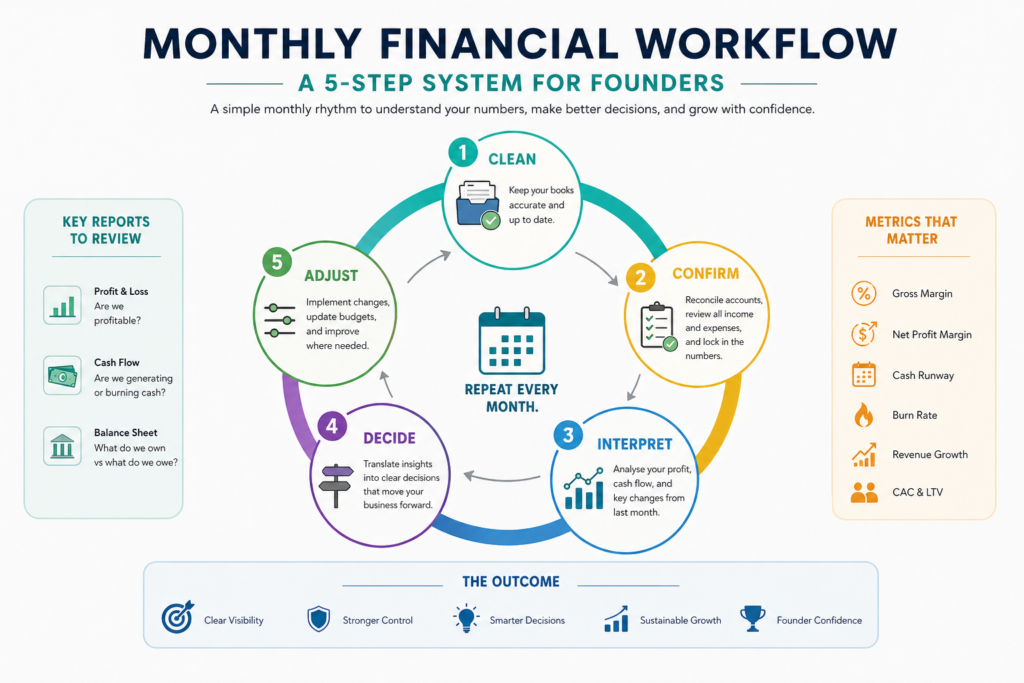
The Shift: From Financial Tasks to Financial Control
Most founders think in terms of tasks:
- “I need to send invoices”
- “I should check the numbers”
- “We need to look at cash flow”
But a strong Financial Workflow reframes everything into control points.
Instead of asking “What do I need to do?”
You start asking “What do I need to know—and what will I do about it?”
That shift is what turns finance into a strategic advantage.
The 5-Step Financial Workflow That Actually Works
Forget complicated finance frameworks.
A practical Financial Workflow follows five steps every month:
- Clean
- Confirm
- Interpret
- Decide
- Adjust
Simple structure. Powerful impact.
Step 1: Clean — Build a Financial Workflow You Can Trust
This is the foundation of your entire Financial Workflow.
If your data is messy, your decisions will be wrong.
What “clean” really means:
- Every transaction is categorised correctly
- Personal and business expenses are separated
- Duplicate or unclear entries are resolved
- Payment platforms (Stripe, PayPal, etc.) are reconciled
- Receipts and supporting records are attached where needed
Founder insight:
You’re not just organising data—you’re removing uncertainty.
A clean Financial Workflow reduces friction later.
Step 2: Confirm — Lock Your Financial Reality in Place
Now you move from “clean enough” to financially accurate.
This stage of your Financial Workflow ensures nothing is missing.
Confirm the essentials:
- Revenue recorded matches actual sales
- All expenses are captured (including subscriptions and hidden costs)
- Bank balances match your accounting system
- Payroll is fully reflected
- Taxes are accounted for (even if not yet paid)
Important definition:
Accrual vs Cash (simple explanation):
- Cash basis = money when it moves
- Accrual basis = money when it’s earned or owed
Your Financial Workflow should at least be consistent—even if simple.
Step 3: Interpret — Turn Your Financial Workflow Into Insight
This is where most workflows break down.
Founders look at numbers—but don’t translate them.
A strong Financial Workflow forces interpretation.
The Three Core Questions Every Month
1. Are we profitable?
Look at your Profit & Loss (P&L).
- Revenue
- Cost of goods/services
- Operating expenses
Definition:
Profit = what’s left after all costs.
2. Are we generating or losing cash?
Look at your cash position.
Definition:
Cash flow = the movement of money in and out of your business.
3. What changed—and why?
Compare this month to last month.
- Revenue up or down?
- Costs increasing?
- Margins improving or shrinking?
Founder rule:
If you can’t explain your numbers in plain English, your Financial Workflow isn’t complete.
Step 4: Decide — The Point of a Financial Workflow
This is where finance becomes leadership.
A strong Financial Workflow leads to clear decisions every month.
Decisions you should be making:
Cost Control
- What can we reduce or eliminate?
- Are subscriptions still justified?
Growth Investment
- Can we spend more on marketing?
- Is there room to hire?
Pricing
- Are margins strong enough?
- Do we need to increase prices?
Risk Management
- Are we overexposed to one client?
- Is cash runway shrinking?
Key definition:
Runway = how many months your business can operate with current cash.
Your Financial Workflow should make this visible every month.
Step 5: Adjust — Make Your Financial Workflow a Loop, Not a Task
This is what closes the system.
After decisions, you adjust your business.
What adjustment looks like:
- Updating budgets
- Changing spending limits
- Reallocating resources
- Tightening payment terms
- Improving invoice collection
Without this step, your Financial Workflow becomes passive.
With it, it becomes a growth engine.
Financial Workflow in Action: A Real Monthly Structure
Let’s make this practical.
Weekly (30–60 minutes)
- Keep transactions updated
- Monitor cash balance
- Check incoming/outgoing payments
Month-End (2–4 hours)
Run the full Financial Workflow:
- Clean
- Confirm
- Interpret
- Decide
- Adjust
Post-Review (Immediate)
- Implement 2–3 key decisions
- Communicate changes (if needed)
- Track impact next month
The Metrics That Strengthen Your Financial Workflow
As your business grows, your Financial Workflow should include key metrics:
Profitability Metrics
- Gross margin
- Net profit margin
Efficiency Metrics
- Operating expenses as % of revenue
- Cost per customer
Growth Metrics
- Revenue growth rate
- Customer lifetime value (LTV)
Stability Metrics
- Cash runway
- Burn rate
Simple definition:
Burn rate = how quickly you’re spending cash.
Financial Workflow and Founder Psychology
This part is rarely discussed—but matters.
Many founders avoid finances because:
- It feels overwhelming
- The numbers feel “behind”
- There’s fear of what they’ll find
A consistent Financial Workflow removes that anxiety.
You’re no longer reacting to surprises.
You’re managing expectations.
When to Upgrade Your Financial Workflow
As your business grows, your workflow should evolve.
Early Stage
- Simple tracking
- Founder-led
- Basic reports
Growth Stage
- Monthly reporting discipline
- Forecasting introduced
- Finance support (part-time or external)
Scale Stage
- Advanced forecasting
- Scenario planning
- CFO-level insights
The structure stays the same.
The depth increases.
Common Financial Workflow Mistakes (That Cost Founders Real Money)
- Relying only on bank balance
- Ignoring small expenses (they compound)
- Not reviewing numbers monthly
- Treating finance as “admin”
- Waiting until there’s a problem
A broken Financial Workflow doesn’t fail loudly—it fails slowly.
Connecting Your Financial Workflow to Long-Term Financial Health
Your monthly actions shape your long-term outcomes.
A consistent Financial Workflow leads to:
- Predictable cash flow
- Sustainable growth
- Strong margins
- Better decision-making
To understand what that looks like in practice, read:
What “Good Financial Health” Looks Like in a Business
Final Thoughts: Your Financial Workflow Is Your Competitive Advantage
Most businesses don’t fail because of bad ideas.
They fail because they run out of clarity—and then cash.
A strong Financial Workflow solves both.
It gives you:
- Visibility
- Control
- Confidence
And over time, that compounds into something powerful:
Better decisions. Better timing. Better outcomes.