
Why Small Businesses Fail Without Proper Financial Systems
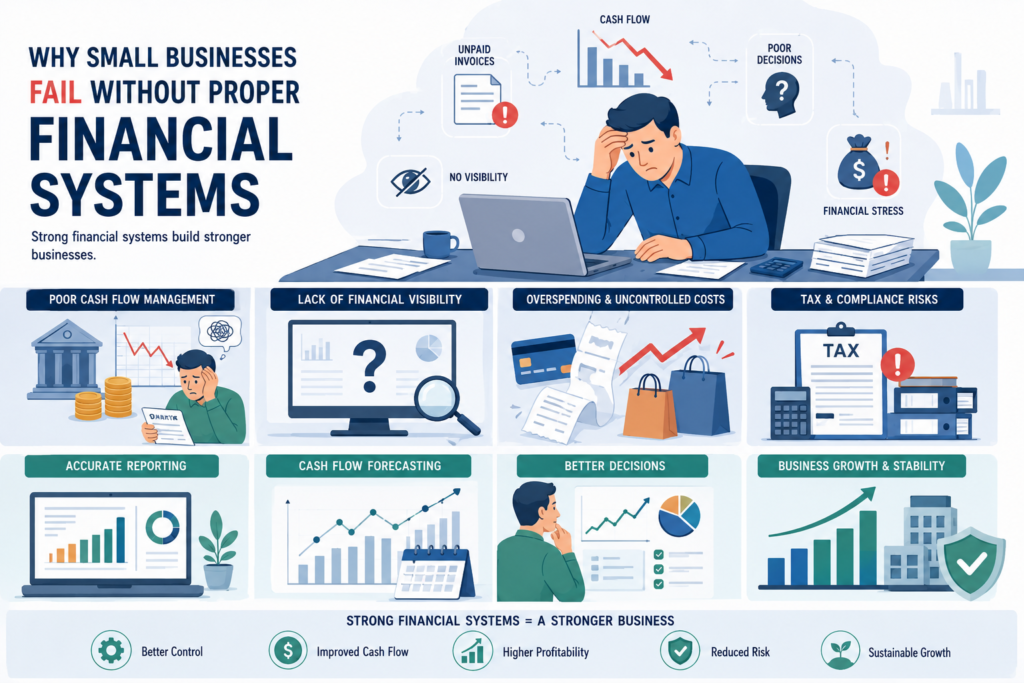
Many small businesses do not fail because of bad products or lack of customers. They fail because the numbers are not under control. Revenue might look healthy. Sales may be growing. The business owner may even feel busy every day. But underneath the surface, poor processes, weak reporting, and inconsistent financial management slowly create problems that become difficult to recover from. This is why proper Financial Systems matter.
Without strong financial systems, businesses struggle to manage cash flow, track profitability, forecast growth, control expenses, prepare for tax obligations, or make confident decisions. Eventually, financial confusion leads to operational problems.
The reality is simple:
A business cannot scale successfully if its finances are disorganised.
In this article, we will break down why businesses fail without proper financial systems, the warning signs to look for, and how small businesses can build financial systems that support long-term growth and stability.
What Are Financial Systems?
Financial Systems are the processes, tools, reports, and controls a business uses to manage money and financial information.
They include:
- Accounting software
- Bookkeeping processes
- Expense tracking
- Cash flow management
- Budgeting
- Payroll systems
- Financial reporting
- Forecasting
- Tax management
- Approval workflows
- KPI tracking
Good financial systems help businesses answer critical questions quickly:
- How much cash do we have?
- Are we profitable?
- Which products or services make the most money?
- What expenses are increasing?
- Can we afford to hire?
- Are customers paying on time?
- What happens if sales slow down?
Without clear answers, businesses operate blindly.
Why Financial Systems Are Essential for Small Businesses
Many founders delay building proper financial systems because they think systems are only necessary for large companies.
That is a costly mistake.
In reality, small businesses need strong systems even more because they usually operate with:
- Smaller cash reserves
- Limited staff
- Less margin for error
- Higher financial pressure
- Faster decision-making cycles
When financial information is inaccurate or delayed, small businesses feel the impact immediately.
Strong financial systems create:
- Better visibility
- Faster decisions
- Improved cash flow
- Reduced financial risk
- Easier tax compliance
- Greater investor confidence
- More predictable growth
Most importantly, they help business owners stay in control.
The Biggest Reasons Small Businesses Fail Without Financial Systems
Financial Systems Failures Lead to Poor Cash Flow Management
Cash flow problems are one of the leading causes of business failure.
A business can be profitable on paper and still run out of money.
Without proper financial systems, businesses often struggle to:
- Track incoming payments
- Monitor overdue invoices
- Forecast future cash shortages
- Manage supplier payment timing
- Control spending
This creates a dangerous cycle where owners rely on guesswork instead of accurate forecasts.
Common signs include:
- Constantly moving money between accounts
- Struggling to pay suppliers on time
- Missing payroll deadlines
- Using personal funds to cover business costs
- Unexpected tax problems
Good financial systems provide real-time cash visibility and forecasting so businesses can act early instead of reacting too late.
Financial Systems Problems Create Bad Decision-Making
Businesses make decisions every day:
- Hiring staff
- Increasing prices
- Expanding services
- Investing in marketing
- Purchasing inventory
- Opening new locations
Without reliable financial data, those decisions become emotional instead of strategic.
Many business owners rely on:
- Bank balances
- Instinct
- Revenue alone
- Incomplete spreadsheets
But revenue does not equal profit.
Strong financial systems help business owners understand:
- Gross margins
- Operating costs
- Profitability by service
- Customer acquisition costs
- Break-even points
- Future financial risks
Better information leads to better decisions.
Financial Systems Help Prevent Overspending
One of the most common problems in growing businesses is uncontrolled spending.
Without proper oversight, expenses increase gradually:
- Software subscriptions
- Contractor costs
- Marketing spend
- Office expenses
- Inventory purchases
- Staff costs
Small increases across multiple areas quickly damage profitability.
Poor financial systems make it difficult to:
- Track expense trends
- Identify waste
- Set spending controls
- Approve purchases properly
Businesses often realise there is a problem only after profits disappear.
Good financial systems introduce accountability and visibility into spending.
Weak Financial Systems Make Tax Compliance Difficult
Tax problems can seriously damage small businesses.
Without organised financial systems, businesses may:
- Miss filing deadlines
- Underestimate tax liabilities
- Lose important records
- Misclassify expenses
- Submit inaccurate reports
This increases the risk of:
- Penalties
- Interest charges
- HMRC investigations
- Cash flow pressure
Good financial systems simplify compliance by keeping records organised throughout the year instead of creating panic during tax season.
Financial Systems Improve Business Forecasting
Many businesses fail because they only focus on today.
Proper forecasting helps businesses prepare for:
- Seasonal slowdowns
- Hiring needs
- Economic uncertainty
- Market changes
- Growth opportunities
- Rising operational costs
Without forecasting systems, businesses operate reactively.
Strong financial systems allow businesses to forecast:
- Revenue
- Expenses
- Profitability
- Cash flow
- Staffing needs
- Funding requirements
Forecasting creates stability and confidence.
Poor Financial Systems Damage Investor and Lender Confidence
If a business wants investment, financing, or external funding, financial systems become critical.
Investors and lenders want to see:
- Accurate reports
- Clean bookkeeping
- Predictable cash flow
- Reliable forecasting
- Financial discipline
Disorganised records create doubt immediately.
Even profitable businesses may struggle to secure funding if their financial systems appear weak or unreliable.
Strong financial systems build credibility.
Common Warning Signs of Weak Financial Systems
Many businesses already have warning signs but ignore them because operations still appear manageable.
Here are some of the biggest red flags:
Financial Systems Warning Sign: No Regular Financial Reports
If the business owner does not review monthly reports consistently, visibility is limited.
Key reports should include:
- Profit and loss statement
- Balance sheet
- Cash flow report
- KPI dashboard
Without these reports, decision-making becomes reactive.
Financial Systems Warning Sign: Everything Lives in Spreadsheets
Spreadsheets are useful, but relying entirely on them creates risks:
- Human errors
- Version confusion
- Missing data
- Broken formulas
- Lack of automation
Growing businesses eventually outgrow spreadsheet-only finance management.
Financial Systems Warning Sign: Personal and Business Finances Are Mixed
This is extremely common in small businesses.
Using personal accounts for business spending creates:
- Accounting confusion
- Tax complications
- Poor visibility
- Compliance risks
Proper financial systems separate personal and business finances completely.
Financial Systems Warning Sign: No Cash Flow Forecast
Many businesses only realise cash problems after they happen.
A proper financial system should include cash flow forecasting for at least:
- 30 days
- 90 days
- 12 months
This helps businesses prepare before problems become critical.
Financial Systems Warning Sign: Financial Data Is Always Delayed
If reports are consistently late, business owners are making decisions using outdated information.
Strong financial systems provide timely and accurate reporting.
How Small Businesses Can Build Better Financial Systems
The good news is that financial systems do not need to be overly complicated.
The goal is clarity, consistency, and visibility.
Start With Proper Accounting Software
Cloud accounting platforms improve efficiency dramatically.
Good accounting software helps automate:
- Invoicing
- Bank reconciliation
- Expense tracking
- Reporting
- Payroll integration
- VAT tracking
This reduces manual work and improves accuracy.
Create Consistent Financial Processes
Strong financial systems rely on repeatable processes.
Examples include:
- Weekly bookkeeping reviews
- Monthly reporting cycles
- Expense approval workflows
- Invoice follow-ups
- Budget reviews
- Cash flow forecasting
Consistency matters more than complexity.
Track the Right KPIs
Financial systems become more powerful when businesses monitor key metrics regularly.
Important KPIs may include:
- Revenue growth
- Gross profit margin
- Net profit margin
- Cash runway
- Debtor days
- Operating expenses
- Customer acquisition costs
KPIs help businesses identify problems early.
Improve Financial Visibility Across the Business
Financial information should not stay hidden inside accounting software.
Leadership teams need visibility into:
- Budgets
- Performance
- Profitability
- Forecasts
- Financial risks
Better visibility creates stronger decision-making.
Work With Financial Professionals
Many small businesses wait too long before getting financial support.
An experienced financial partner can help implement:
- Financial systems
- Forecasting models
- Reporting structures
- KPI dashboards
- Cash flow management
- Strategic planning
This gives businesses stronger financial foundations.
The Long-Term Benefits of Strong Financial Systems
Businesses with proper financial systems are usually:
- More profitable
- More stable
- Better organised
- More scalable
- Better prepared for downturns
- More attractive to investors
- Easier to manage
Financial systems do not just protect businesses from failure.
They help businesses grow with confidence.
Final Thoughts
Small businesses rarely collapse overnight.
Most failures happen gradually through poor visibility, weak processes, inconsistent reporting, and unmanaged financial risks.
That is why proper Financial Systems are not optional.
They are essential.
The earlier a business builds strong financial systems, the easier it becomes to manage growth, improve profitability, control cash flow, and make smarter decisions.
Businesses that understand their numbers are far more likely to survive economic uncertainty and scale successfully over time.
If your business needs help improving its financial systems, reporting, forecasting, or financial processes, the team at Tookand Contact Page can help you build systems that support long-term growth.