Financial Reports for Decision Making: How to Read Financial Statements as a Non-Finance Founder
If you’re a founder who avoids spreadsheets, you’re not alone. Most business owners don’t struggle because they lack vision. They struggle because they don’t fully understand their financial reports for decision making. And without clarity on the numbers, every decision feels like a gamble.
This guide breaks everything down in plain English. No accounting jargon. No textbook theory. Just what you need to know to read financial statements with confidence and use them to grow your business.
Why Financial Reports for Decision Making Matter More Than Revenue
Revenue looks impressive. But revenue alone doesn’t tell you:
- Whether you’re profitable
- Whether you’re running out of cash
- Whether you can afford to hire
- Whether your pricing works
- Whether your growth is sustainable
This is where financial reports for decision making become critical. They show you what’s really happening beneath the surface.
Think of them as your business dashboard. If you ignore them, you’re driving blind.
The Three Core Financial Reports for Decision Making
There are three essential financial reports every founder must understand:
- Profit & Loss Statement (P&L)
- Balance Sheet
- Cash Flow Statement
Let’s simplify each one.
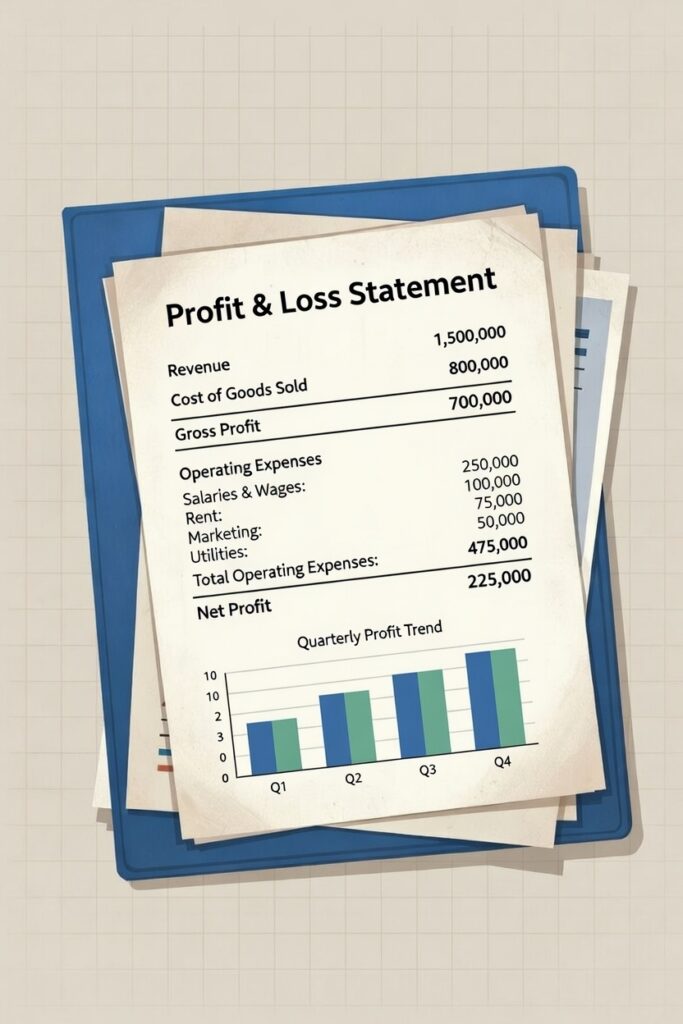
1. The Profit & Loss Statement (Income Statement)
Also called: Income Statement
What It Shows
The P&L tells you whether your business made money over a specific period (month, quarter, or year).
It answers one key question:
Did we make a profit?
Key Sections Explained
Revenue – The total income from sales.
Cost of Goods Sold (COGS) – Direct costs to deliver your product or service (materials, software tools, delivery costs).
Gross Profit – Revenue minus COGS.
This shows how profitable your core offering is.
Operating Expenses (OPEX) – Rent, salaries, marketing, software subscriptions, insurance.
Net Profit – What’s left after all expenses.
This is your real profit.
Why It Matters for Decision Making
The P&L helps you:
- Adjust pricing
- Cut unnecessary costs
- Identify underperforming products
- Decide whether to hire
If revenue is rising but profit is shrinking, something is wrong.
Using Financial Reports for Decision Making: Reading Your Margins
Margins tell you how efficient your business is.
Gross Margin = Gross Profit ÷ Revenue
If your gross margin is low, you may need to:
- Increase prices
- Reduce delivery costs
- Improve operational efficiency
Healthy margins give you breathing room.
2. The Balance Sheet: What You Own vs What You Owe
The Balance Sheet shows your financial position at a single point in time.
Think of it as a snapshot.
It Has Three Parts:
Assets – What the business owns
- Cash
- Equipment
- Accounts receivable (money customers owe you)
Liabilities – What the business owes
- Loans
- Credit cards
- Supplier invoices
Equity – The value left for you (the owner)
The formula:
Assets = Liabilities + Equity
Why This Matters
The Balance Sheet tells you:
- Whether you are over-leveraged
- Whether you rely too heavily on debt
- Whether customers are slow to pay
- Whether your business is building real value
If receivables are high but cash is low, you have a collection problem.
Financial Reports for Decision Making: Understanding Working Capital
Working capital measures short-term financial health.
Working Capital = Current Assets – Current Liabilities
Positive working capital means you can pay bills comfortably.
Negative working capital means stress is coming.
This metric is vital for growing businesses.
3. The Cash Flow Statement: The Most Important Report
Many profitable businesses fail because they run out of cash.
The Cash Flow Statement tracks:
- Cash coming in
- Cash going out
- Where the cash is going
It is divided into:
Operating Activities – Day-to-day business cash
Investing Activities – Buying equipment or assets
Financing Activities – Loans, investments, repayments
Why Founders Must Watch Cash Weekly
You cannot pay salaries with profit.
You pay salaries with cash.
Strong financial reports for decision making always include regular cash flow reviews.
How to Use Financial Reports for Decision Making in Real Scenarios
Let’s make this practical.
Scenario 1: Hiring a New Employee
Check:
- Net profit trend
- Cash reserves
- Forecasted cash flow
If cash is tight, delay hiring.
Scenario 2: Increasing Marketing Spend
Check:
- Gross margin
- Customer acquisition cost
- Return on previous campaigns
If margins are thin, scaling marketing could increase losses.
Scenario 3: Taking a Loan
Check:
- Debt levels on Balance Sheet
- Cash flow stability
- Working capital
Never borrow to cover consistent operational losses.
Financial Reports for Decision Making: Common Mistakes Founders Make
- Only looking at revenue
- Ignoring cash flow
- Not reviewing reports monthly
- Mixing personal and business expenses
- Not understanding margins
The fix? Review reports consistently. Even 30 minutes a month can change everything.
Simple Monthly Review Framework for Non-Finance Founders
Here’s a simple process:
Step 1: Review revenue trend
Step 2: Review gross margin
Step 3: Review net profit
Step 4: Check cash position
Step 5: Review outstanding receivables
Step 6: Compare to previous month
Ask one key question:
“What decision do these numbers require me to make?”
That is how financial reports for decision making should be used.
Financial Reports for Decision Making and Long-Term Growth
When you understand your financial statements, you gain:
- Pricing confidence
- Investor readiness
- Better negotiations with suppliers
- Clearer hiring decisions
- Strategic clarity
Numbers stop being scary. They become strategic tools.
If you want a deeper breakdown of how financial statements work and how to interpret each section clearly, you can explore our related guide.
Final Thoughts
You don’t need to be an accountant to understand your business.
You just need clarity.
Financial reports for decision making are not about compliance. They are about control. When you read your numbers regularly, you move from guessing to leading.
And that is when real growth begins.