Small Business Funding: A Practical Guide for Founders (Including SBA Loans Explained)
Introduction: Why Small Business Funding Matters More Than Ever
Small Business Funding is one of the most misunderstood parts of building a company. Many founders assume funding is only for startups chasing investors or businesses in trouble. In reality, funding is a strategic growth tool, when used at the right time and for the right reasons.
Most small businesses eventually reach a point where growth slows not because demand is missing, but because cash is constrained. Hiring is delayed, inventory is limited, expansion plans get postponed, and founders end up operating defensively instead of strategically.
Understanding how Small Business Funding works, especially structured options like SBA loans, allows founders to grow on their own terms without giving up ownership or control.
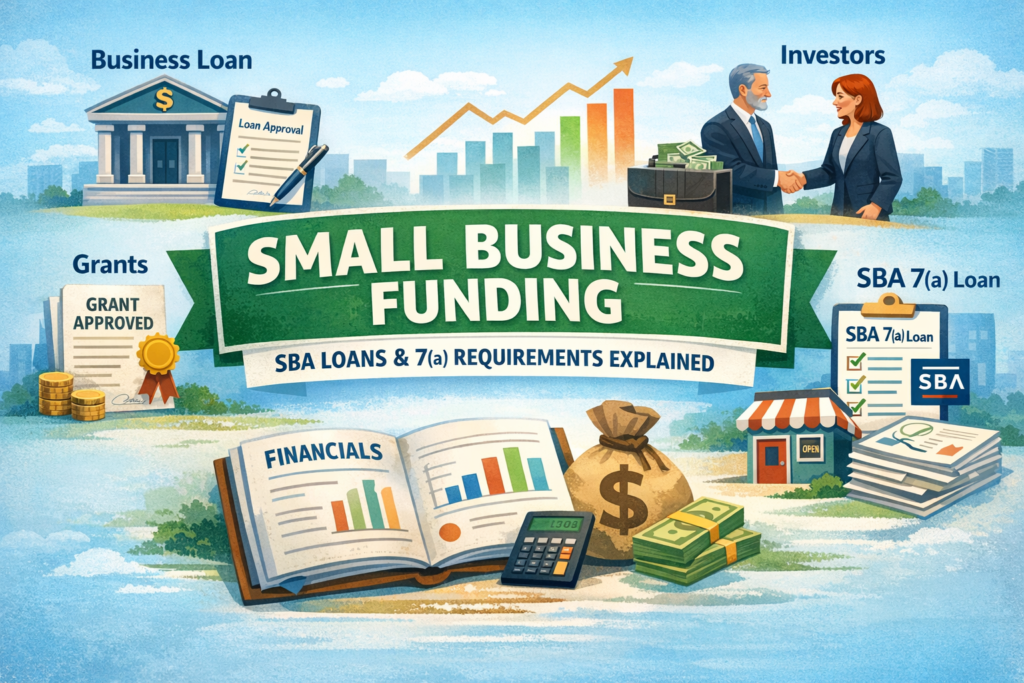
What Small Business Funding Actually Means
At its core, Small Business Funding is about accessing capital to support operations, growth, or stability. That capital can come from external sources, internal cash flow, or a combination of both.
Funding is typically used to:
- Expand operations or locations
- Hire revenue-generating staff
- Purchase inventory or equipment
- Smooth cash flow gaps
- Refinance expensive debt
The key distinction is this: funding should accelerate a business that already works, not compensate for one that doesn’t.
The Main Types of Small Business Funding
Not all funding is created equal. Each option has implications for cost, risk, speed, and control.
Debt-Based Small Business Funding
Debt funding means borrowing money and repaying it over time, usually with interest. This is the most common form of Small Business Funding for established businesses.
Loans work best when a business has predictable revenue and a clear plan for repayment. The advantage is simple: you keep full ownership. The downside is responsibility — repayments happen regardless of how the business performs.
This category includes traditional bank loans, online lenders, and SBA-backed loans.
Equity-Based Small Business Funding
Equity funding involves exchanging ownership for capital. Investors expect returns through growth, dividends, or a future exit.
While equity funding can unlock large sums of capital, it also introduces shared control, external expectations, and long-term dilution. For many small businesses, this trade-off isn’t necessary — especially when debt-based funding can support steady growth.
Grants and Non-Dilutive Funding
Grants are often attractive because they don’t require repayment. However, they are limited, competitive, and typically tied to specific use cases such as innovation, research, or underserved founder groups.
Grants are best viewed as supplemental funding, not a primary growth strategy.
Small Business Funding Through SBA Loans Explained
One of the most misunderstood funding options is the SBA loan.
The Small Business Administration does not lend money directly. Instead, it guarantees a portion of loans issued by approved lenders. This guarantee reduces the lender’s risk, making it easier for small businesses to qualify for financing they might not otherwise access.
Because of this structure, SBA loans tend to offer longer repayment terms, lower interest rates, and more flexible qualification standards than many traditional loans.
SBA 7(a) Loan Requirements Explained in Plain English
The SBA 7(a) loan is the most widely used SBA program and often the first option founders explore when seeking Small Business Funding.
Lenders don’t look for perfection. They look for confidence that the business can repay the loan.
First, the business must be operating and for-profit. Startups can qualify, but most approvals go to businesses with some operating history.
Second, lenders want to see owner investment. This “skin in the game” shows commitment. It can include cash invested, retained earnings, or assets already contributed to the business.
Credit history matters, but it’s not about having a flawless score. Lenders focus more on patterns — consistent repayment, responsible use of credit, and no recent major red flags.
Finally, repayment ability is critical. Lenders analyze whether the business generates enough cash to comfortably service debt after covering operating expenses. This is where many applications fall apart — not because the business is weak, but because the financials are unclear.
How Small Business Funding Decisions Are Really Made
Founders often think funding decisions hinge on big ideas or ambitious projections. In reality, lenders focus on risk reduction.
They ask practical questions:
- Is revenue stable or growing?
- Are expenses controlled?
- Does the founder understand their numbers?
Clear financial reporting, realistic assumptions, and a defined use of funds often matter more than aggressive growth forecasts.
This is why two similar businesses can apply for funding and receive very different outcomes.
Preparing Financials for Small Business Funding
Preparation is the single biggest differentiator in successful Small Business Funding applications.
Lenders expect to see three core financial statements: a profit and loss statement, a balance sheet, and a cash flow statement. These documents tell the story of how the business earns money, what it owns and owes, and how cash actually moves.
Equally important is context. Revenue trends, customer concentration, and expense consistency help lenders understand risk. Even simple, well-organized financials are far more effective than complex reports no one can explain.
When Small Business Funding Makes Sense
Funding works best when it supports growth that already exists.
Strong use cases include scaling a proven product, expanding capacity to meet demand, hiring roles that directly drive revenue, or replacing expensive short-term debt with structured financing.
In contrast, funding rarely fixes broken pricing models, unclear operations, or persistent losses. In those cases, capital often delays hard decisions rather than solving the underlying issue.
SBA Loans Compared to Other Small Business Funding Options
SBA loans often sit between traditional bank loans and alternative lenders. They aren’t the fastest option, but they are among the most founder-friendly.
Compared to high-interest online lenders, SBA loans offer significantly better long-term economics. Compared to investors, they preserve ownership and control.
For many founders, SBA-backed Small Business Funding represents the most balanced path to sustainable growth.
Final Thoughts: Build Toward Funding Readiness
The strongest funding position is optionality.
Founders who understand their numbers, maintain clean financials, and plan ahead don’t scramble for capital, they choose it.
When your business is prepared, Small Business Funding becomes a strategic lever rather than a last resort.
Want to learn more about Small Business Finance, here is an article for you.