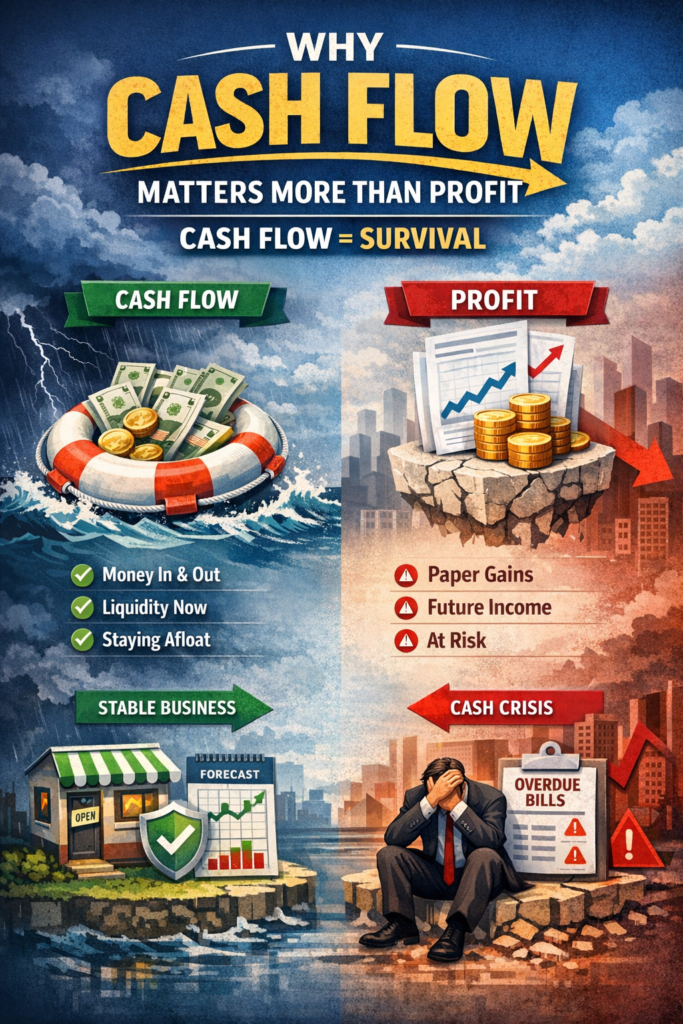
Why Cash Flow Matters More Than Profit
In today’s climate, geopolitical tensions, inflation pressure, interest rate shifts, and unpredictable markets, cash flow has become the most important number in your business.
Not revenue.
Not profit.
Cash flow.
Because while profit is an accounting outcome, cash flow is reality.
You don’t fail because your business isn’t profitable.
You fail because you run out of cash.
This builds on our previous guide:
👉 How to Manage Cash Flow During Economic Uncertainty
Now we’re going deeper—into strategy, structure, and decision-making.
What Is Cash Flow (Simple Definition for Non-Finance Founders)
Let’s break it down clearly.
Cash flow = the movement of money in and out of your business.
- Cash inflow: money coming in (sales, payments, funding)
- Cash outflow: money going out (rent, salaries, suppliers, taxes)
👉 If more cash comes in than goes out → positive cash flow
👉 If more cash goes out than comes in → negative cash flow
Key point:
Cash flow is about timing, not just totals.
Why Cash Flow Matters More Than Profit (Core Concept)
Profit is calculated using accounting rules.
Cash flow is based on actual money available.
Example:
- You close $100,000 in sales
- Your costs are $70,000
- Profit = $30,000 ✅
But…
- Customers pay in 60 days
- Expenses are due now
Result:
You have profit—but no cash.
That gap is where businesses collapse.
Cash Flow vs Profit: A Clear Breakdown
| Metric | What It Tells You | Limitation |
|---|---|---|
| Profit | Are you making money overall? | Doesn’t show timing |
| Cash Flow | Do you have money right now? | Requires active management |
👉 Profit = performance
👉 Cash flow = survival
Why Cash Flow Matters More Than Profit in Economic Uncertainty
Economic uncertainty magnifies cash flow risk.
1. Customers Delay Payments
Even reliable clients stretch terms.
2. Revenue Becomes Less Predictable
Sales cycles lengthen.
3. Costs Increase Unexpectedly
Inflation, supply shocks, currency shifts.
4. Financing Becomes Harder
Loans take longer or cost more.
5. Risk Compounds Quickly
One delay can trigger a chain reaction.
In this environment, cash flow becomes your buffer against instability.
Cash Flow Timing: The Hidden Risk Most Founders Ignore
Most businesses don’t fail because of poor margins.
They fail because of timing mismatches.
Common timing gaps:
- Paying suppliers in 30 days but getting paid in 60
- Hiring before revenue is realised
- Investing upfront without staged returns
This creates cash flow gaps—periods where your bank balance drops dangerously low.
Cash Flow Management: What It Actually Means
Good cash flow management is not just tracking money.
It’s about control.
It means:
- Knowing your exact cash position at all times
- Planning inflows and outflows
- Making decisions based on liquidity—not assumptions
Think of it as financial navigation, not just reporting.
Cash Flow Forecasting: The Most Underrated Tool in Business
A cash flow forecast predicts how much cash you’ll have in the future.
Why it matters:
- Prevents surprises
- Helps you plan growth safely
- Gives you time to act
Simple structure:
- Opening balance
- Expected inflows (by date)
- Expected outflows (by date)
- Closing balance
👉 Even a basic 13-week forecast can dramatically improve control.
Cash Flow and Growth: Why Scaling Can Break Your Business
Growth feels positive—but it often consumes cash before it generates it.
Examples:
- Hiring staff before revenue catches up
- Marketing spend with delayed ROI
- Expanding inventory
This creates working capital pressure.
Working capital (simple definition):
Money needed to run daily operations.
If growth outpaces your cash flow, it becomes dangerous.
Cash Flow Risks Hidden in Everyday Operations
These are common—and often missed:
Long Payment Terms
You act like a bank for your customers.
Customer Concentration Risk
One late payer = major disruption.
Subscription Mismatch
Monthly costs vs annual payments.
Over-reliance on Debt
Short-term fixes create long-term strain.
Tax Surprises
Taxes hit when cash is already tight.
Cash Flow Strategies That Strengthen Your Business
Here are practical, proven actions:
1. Improve Cash Inflow Speed
- Invoice immediately
- Reduce payment terms (e.g. 30 → 14 days)
- Offer early payment discounts
2. Delay Cash Outflows (Strategically)
- Negotiate supplier terms
- Use staged payments
- Align expenses with revenue timing
3. Build a Cash Buffer
Target:
- Minimum: 3 months of expenses
- Ideal: 6+ months
This gives you breathing room in uncertainty.
4. Increase Cash Flow Predictability
- Use subscriptions or retainers
- Secure upfront deposits
- Lock in recurring revenue
5. Monitor Cash Flow Weekly (Not Monthly)
Monthly is too slow.
Weekly tracking gives you:
- Faster reaction time
- Better control
- Less stress
Cash Flow and Pricing Strategy: A Strategic Lever
Pricing isn’t just about margins—it’s about cash flow structure.
Better models:
- Upfront pricing
- Milestone billing
- Subscription models
Risky models:
- Long deferred payments
- Pay-on-delivery without deposits
Your pricing model directly shapes your cash flow stability.
Cash Flow Visibility: Why Most Businesses Lack It
Most founders don’t have a clear picture of their cash position.
Why?
- Disconnected tools
- Delayed reporting
- No forecasting
- Over-reliance on bank balance
👉 Your bank balance is not your cash flow strategy.
Cash Flow Systems: What You Actually Need
A strong financial system should give you:
- Real-time visibility
- Forecasting capability
- Clear dashboards
- Scenario planning
Without systems, cash flow management becomes guesswork.
Cash Flow Stress Signals You Should Never Ignore
Watch for these early warning signs:
- Delaying supplier payments
- Struggling to meet payroll
- Increasing reliance on overdrafts
- Chasing receivables constantly
- Avoiding looking at finances
These are not small issues—they’re signals of deeper cash flow problems.
Cash Flow in Crisis: What to Do Immediately
If cash is tight:
- Prioritise critical payments (payroll, core suppliers)
- Accelerate receivables (chase payments aggressively)
- Cut non-essential spend immediately
- Renegotiate terms
- Pause expansion
Focus on stabilisation before growth.
Cash Flow and Business Resilience
Resilient businesses:
- Prioritise liquidity over optics
- Plan conservatively
- Maintain buffers
- Act early
They don’t just survive uncertainty—they navigate it.
Cash Flow Is a Leadership Responsibility (Not Just Finance)
Many founders delegate finance too early.
But cash flow is a leadership metric.
You should know:
- Your current cash position
- Your runway (how long cash lasts)
- Your biggest risks
Because every strategic decision affects cash flow.
Final Thoughts: Cash Flow Is Control
Profit tells you how well your business performs.
Cash flow tells you whether your business survives.
In uncertain times, survival comes first.
When you control your cash flow, you control your business.