
Why Leaving Excess Cash in the Bank Could Cost Your Business Money
Many business owners believe that having a large cash balance sitting in the bank is a sign of financial success.
After all, cash means security, right?
To a point, yes.
Every business needs sufficient cash to pay suppliers, employees, taxes, and unexpected expenses. But there comes a point where cash stops working for your business and starts quietly working against it.
If your business has accumulated more cash than it needs for day-to-day operations, leaving it untouched in a current account could be one of the most expensive financial decisions you’re making.
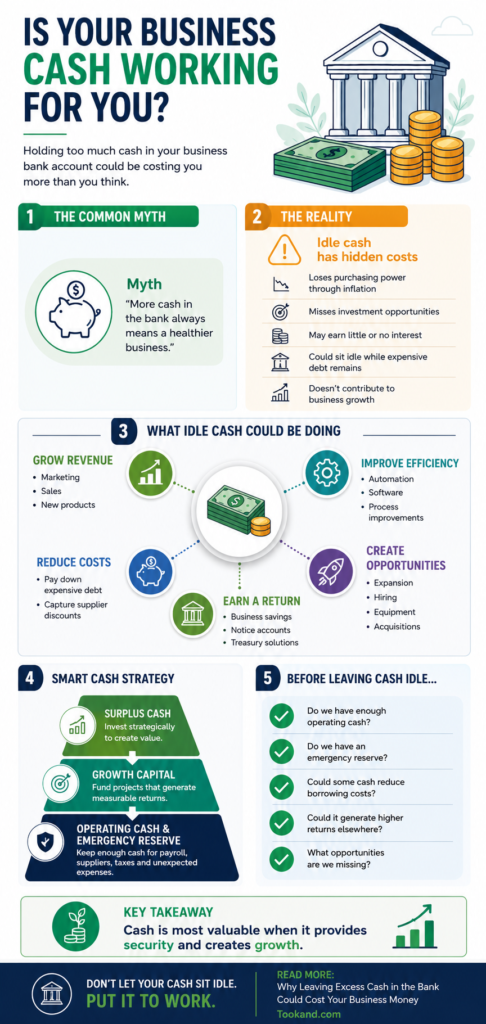
Cash Is an Asset But It Should Still Be Working
Think about every other business asset.
You expect machinery to produce goods.
You expect software to improve productivity.
You expect employees to generate value.
Cash should be no different.
Money that earns little or no return gradually loses purchasing power through inflation. At the same time, it represents opportunities your business isn’t taking, whether that’s investing in growth, reducing costs, or generating additional income.
The goal isn’t to spend money unnecessarily.
It’s to allocate capital intelligently.
The Hidden Cost of Idle Cash
Imagine your business holds $250,000 in a standard business current account earning virtually no interest.
Now consider what that money could be doing instead.
It could:
- Earn interest in a business savings account or treasury product.
- Reduce borrowing by paying down expensive debt.
- Fund automation that saves staff hours every month.
- Finance marketing campaigns with measurable returns.
- Provide capital for expansion into new markets.
- Generate stronger supplier discounts through early payment.
Each of these options has the potential to create value.
Leaving the money untouched creates none.
The cost isn’t always visible on your bank statement, but it’s very real.
Inflation Quietly Erodes Cash
Inflation doesn’t need dramatic headlines to affect your business.
If inflation averages just 3% per year, $100,000 effectively loses around $3,000 of purchasing power annually if it earns no meaningful return.
Over several years, the impact becomes significant.
Your cash balance may look exactly the same.
Its buying power does not.
Opportunity Cost Is Real
One of the most overlooked concepts in business finance is opportunity cost.
Every pound sitting idle represents something else it could have achieved.
For example:
- Could it generate more sales?
- Could it improve customer experience?
- Could it eliminate inefficient manual processes?
- Could it strengthen your competitive position?
- Could it reduce financial risk?
The best businesses don’t simply ask, “Can we afford this?”
They ask, “Is this the highest-value use of our capital?”
Build a Cash Reserve, Not a Cash Mountain
This doesn’t mean businesses should spend every available pound.
Far from it.
Healthy businesses should maintain an emergency reserve that reflects their operating costs and risk profile.
Many finance professionals recommend holding several months of operating expenses, depending on the stability of revenue and the nature of the business.
Beyond that reserve, however, surplus cash deserves a strategy.
Five Smarter Uses for Surplus Cash
1. Strengthen Your Cash Flow
Ironically, investing surplus cash can improve future cash flow.
Examples include:
- automating repetitive tasks;
- improving inventory management;
- upgrading financial systems;
- reducing operational inefficiencies.
These investments often continue paying dividends long after the initial cost.
2. Invest in Revenue Growth
Growth requires investment.
Whether it’s expanding your sales team, improving your website, or increasing marketing activity, carefully planned investments can generate returns that far exceed the interest earned in a current account.
The key is measuring return on investment rather than simply controlling expenditure.
3. Reduce Expensive Debt
If your business is paying interest on loans, overdrafts, or credit facilities while simultaneously holding large idle cash balances, it’s worth reviewing whether those funds could reduce financing costs.
Lower debt often means improved profitability and greater financial flexibility.
4. Earn a Return on Surplus Funds
Not every pound needs to remain instantly accessible.
Depending on your cash flow forecast, surplus funds may be suitable for business savings accounts, notice accounts, or other low-risk treasury solutions.
The objective isn’t speculation.
It’s making idle cash productive while maintaining appropriate liquidity.
5. Prepare for Future Opportunities
Businesses with available capital are often the first to take advantage of unexpected opportunities.
That might include:
- acquiring a competitor;
- purchasing discounted equipment;
- hiring exceptional talent;
- expanding into new markets;
- launching a new product or service.
Strategic cash creates options.
Idle cash simply waits.
Good Cash Management Starts with Visibility
One reason businesses accumulate excessive cash is uncertainty.
If you don’t have confidence in your future cash position, it’s natural to hold more than necessary.
That’s why accurate forecasting is so important.
Understanding expected income, expenses, seasonal fluctuations, and future commitments allows business owners to distinguish between:
- operational cash;
- emergency reserves; and
- genuine surplus capital.
Only then can informed financial decisions be made.
Review Your Cash Strategy Regularly
Cash management isn’t something to review once a year.
As your business grows, customer behaviour changes, or economic conditions shift, your cash requirements will change too.
A quarterly review of your cash position can help identify:
- excess working capital;
- unnecessary borrowing;
- investment opportunities;
- operational improvements; and
- future funding requirements.
Small adjustments made consistently often produce significant long-term benefits.
Final Thoughts
Cash remains one of the most valuable assets any business owns.
But value comes not from simply holding cash, it comes from using it wisely.
The strongest businesses understand the difference between liquidity and inactivity.
They maintain healthy reserves, forecast with confidence, and ensure surplus capital supports long-term growth rather than quietly losing value in the background.
If your business has accumulated more cash than it realistically needs, now may be the right time to ask a simple question:
Is our cash protecting the business or helping it grow?
Further Reading
If you’re looking to improve the way your business manages cash, you may also enjoy our related article, “10 Cash Flow Mistakes Small Businesses Make (and How to Fix Them)“, which explores common financial pitfalls and practical ways to improve cash flow management.