Should Your Business Invest in Commercial Property or Continue Renting?
For many business owners, the question eventually comes up: should we continue renting our premises or invest in Commercial Property instead?
It is a significant decision. Property is often one of the largest expenses a business will face, and choosing whether to own or rent can affect cash flow, growth plans, borrowing capacity, and long-term wealth creation.
There is no universal answer. For some businesses, renting provides flexibility and preserves valuable working capital. For others, owning commercial premises can become a powerful asset that creates stability and long-term value.
The key is understanding how Commercial Property fits into your wider business strategy rather than viewing it simply as a place to operate from.
In this guide, we’ll explore the advantages and disadvantages of ownership, the cash flow implications, tax considerations, and the situations where purchasing commercial premises may be the right move.
Why Businesses Are Considering Commercial Property Ownership
For many business owners, there comes a point when paying rent starts to feel like a missed opportunity.
Month after month, lease payments leave the business bank account without creating any long-term ownership or equity. That often leads to an important question:
Should we continue renting, or should we invest in Commercial Property instead?
The answer depends on far more than monthly occupancy costs. Purchasing commercial real estate can help businesses build wealth, create stability, and gain greater control over their future. However, ownership also requires capital, financing, and long-term commitment.
For some companies, buying a property becomes one of the best investments they ever make. For others, renting remains the smarter financial decision.
In this guide, we’ll examine the pros and cons of investing in Commercial Property, the impact on cash flow, key U.S. tax considerations, and the situations where ownership makes the most sense.
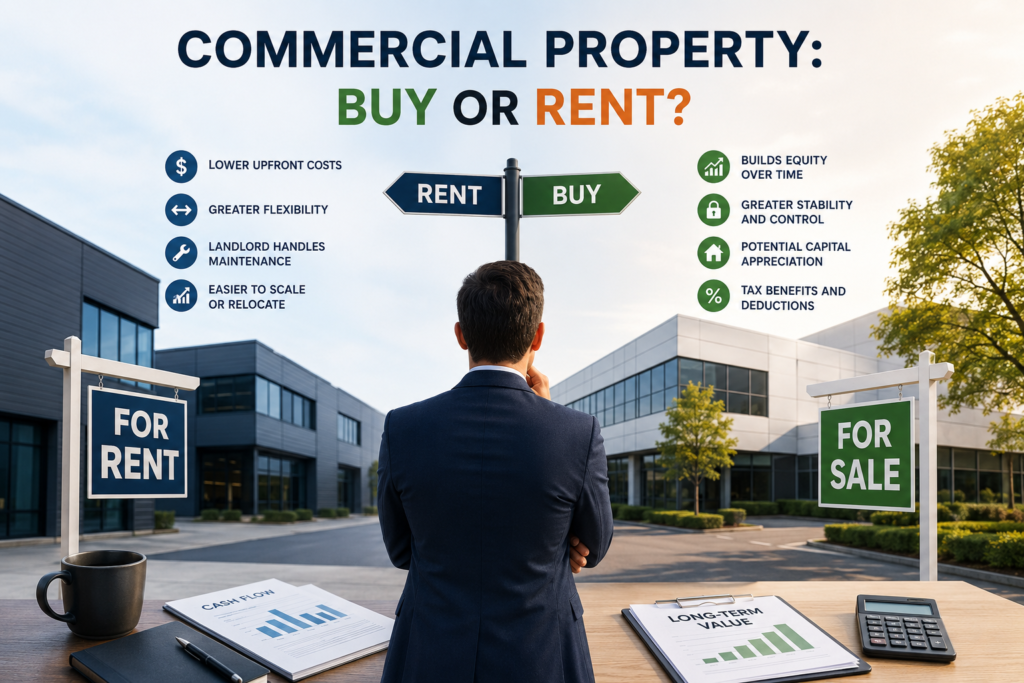
Why More Businesses Are Investing in Commercial Property
Commercial real estate has long been one of the primary ways American business owners build wealth outside their core operations.
Instead of paying rent indefinitely, ownership allows businesses to:
- Build equity over time
- Lock in occupancy costs
- Gain control over their premises
- Potentially benefit from property appreciation
- Create a valuable business asset
For many owners, their largest source of wealth isn’t the income generated by the business itself—it’s the value accumulated through assets such as Commercial Property.
The Pros of Investing in Commercial Property
Commercial Property Helps Build Equity
Perhaps the biggest advantage of ownership is that mortgage payments gradually build equity.
When a business rents, payments are purely an operating expense.
When a business owns property, a portion of each mortgage payment reduces the loan balance and increases ownership in the asset.
Over time, this can create significant value.
A company that owns a $1 million property and steadily pays down debt may accumulate hundreds of thousands of dollars in equity over the life of the loan.
Greater Control Over Business Operations
Owning your premises removes many of the uncertainties associated with leasing.
Businesses gain more control over:
- Facility improvements
- Office renovations
- Building expansion
- Branding and signage
- Long-term occupancy plans
This can be particularly important for manufacturers, medical practices, restaurants, distribution businesses, and retail operators.
Protection Against Rising Rental Costs
Commercial lease rates can increase significantly over time.
A long-term mortgage often provides greater predictability than a lease that is subject to periodic rent reviews.
For businesses planning to stay in one location for many years, ownership can help stabilize occupancy costs.
Potential Appreciation in Property Value
Commercial real estate values may appreciate over time depending on:
- Economic growth
- Population trends
- Local development
- Market demand
- Property improvements
While appreciation is never guaranteed, it can significantly increase overall returns from ownership.
The Cons of Buying Commercial Property
Large Upfront Capital Requirements
Purchasing commercial real estate typically requires:
- Down payment
- Legal fees
- Appraisal fees
- Environmental assessments
- Loan closing costs
- Initial improvements
Even with financing, substantial capital is often required.
For many growing businesses, that money may generate a higher return if invested elsewhere.
Reduced Business Flexibility
Businesses evolve.
A company may:
- Expand rapidly
- Change markets
- Adopt remote work
- Open additional locations
Renting allows businesses to adjust more easily as circumstances change.
Commercial property ownership creates a longer-term commitment that may limit flexibility.
Maintenance and Property Responsibilities
Ownership means taking responsibility for:
- Building repairs
- Structural issues
- HVAC systems
- Roof maintenance
- Property insurance
- Property taxes
These costs can be substantial and should always be included in financial projections.
Commercial Property and Cash Flow: The Most Important Consideration
Cash Flow Matters More Than Ownership
Many business owners focus on whether they can qualify for financing.
A better question is:
Can the business comfortably afford ownership without restricting growth?
Strong cash flow remains essential regardless of whether a company owns or rents.
Before purchasing commercial property, business owners should evaluate:
- Working capital requirements
- Growth plans
- Debt obligations
- Emergency reserves
- Seasonal revenue fluctuations
Ownership should improve the financial position of the business, not create cash flow pressure.
Understanding the True Cost of Ownership
Comparing rent to a mortgage payment alone can be misleading.
Commercial property ownership often includes:
- Mortgage payments
- Property taxes
- Insurance
- Repairs
- Maintenance
- Capital improvements
- Utilities
- Property management costs
A complete financial analysis should compare total occupancy costs rather than just rent versus mortgage payments.
Consider the Opportunity Cost
Capital used to purchase property cannot be used elsewhere.
For example, a $250,000 down payment could alternatively fund:
- New equipment
- Additional staff
- Marketing campaigns
- Acquisitions
- Product development
The best decision depends on where that capital can generate the highest long-term return.
Tax Considerations for Commercial Property Ownership in the United States
Depreciation Benefits
One of the most significant tax advantages of owning Commercial Property is depreciation.
Commercial buildings are generally depreciated over 39 years for federal tax purposes.
Depreciation can provide valuable deductions that reduce taxable income.
Section 179 and Bonus Depreciation
Certain improvements and qualifying property components may be eligible for accelerated deductions through:
- Section 179 expensing
- Bonus depreciation provisions
These incentives can improve the after-tax return on property investments.
Mortgage Interest Deductions
Interest paid on commercial real estate loans is generally deductible as a business expense.
This can reduce the effective cost of borrowing and improve overall cash flow.
Property Tax Considerations
Property taxes vary significantly across states and municipalities.
Business owners should factor local tax rates into ownership calculations before purchasing.
A lower purchase price in one state may be offset by higher annual property taxes.
Capital Gains Considerations
If a property is sold in the future at a profit, capital gains taxes may apply.
Ownership structure can have a major impact on future tax liabilities.
Proper tax planning before acquisition is often just as important as the purchase itself.
SBA Financing and Commercial Property Ownership
Many small businesses are unaware that government-backed financing may make ownership more accessible.
Programs such as the SBA 504 Loan Program can help businesses purchase owner-occupied commercial real estate with lower down payment requirements than traditional commercial loans.
Benefits often include:
- Lower upfront capital requirements
- Long repayment terms
- Fixed interest rate options
- Improved cash flow flexibility
For qualifying businesses, SBA-backed financing can significantly improve the economics of ownership.
When Commercial Property Ownership Makes Sense
You Plan to Stay in One Location Long Term
The longer you expect to occupy a property, the stronger the ownership case becomes.
Businesses planning to remain in the same location for ten years or more often benefit most from purchasing.
Your Business Generates Consistent Cash Flow
Stable revenue and predictable cash generation create a stronger foundation for ownership.
The ability to comfortably service debt should be a key requirement before purchasing.
You Have Adequate Cash Reserves
Property ownership should never leave a business cash-poor.
Maintaining healthy reserves remains critical for:
- Economic downturns
- Unexpected expenses
- Growth opportunities
- Operational disruptions
Commercial Property Supports Your Wealth Strategy
Many successful entrepreneurs think beyond annual profits.
They focus on building assets that appreciate and generate long-term value.
Commercial real estate can play a major role in that strategy.
For additional insight into building business wealth through assets, read:
When Renting Is Still the Better Choice
Renting often makes sense when:
- Growth plans are uncertain
- Cash reserves are limited
- Flexibility is a priority
- Expansion is likely
- Capital can earn higher returns elsewhere
Many highly successful companies lease their premises throughout their entire lifecycle.
Ownership is not always the best path.
The right decision depends on financial objectives, growth plans, and overall business strategy.
Final Thoughts
The decision to buy or lease is one of the most significant financial choices a business owner can make.
Investing in Commercial Property can create equity, provide stability, and contribute to long-term wealth creation. However, ownership also requires capital, discipline, and careful planning.
The most successful businesses evaluate property decisions through the lens of cash flow, return on investment, tax efficiency, and strategic objectives.
Whether you choose to buy or rent, the goal should remain the same: position your business for sustainable growth while building long-term financial strength.