Federal Reserve Holds Interest Rates: What It Means for Businesses in 2026
The U.S. Federal Reserve has once again decided to leave interest rates unchanged, maintaining the federal funds target range at 3.50%–3.75%. While there was no immediate rate increase, the meeting delivered a much stronger message than many expected: the fight against inflation is far from over.
Markets reacted quickly.
Stocks fell, Treasury yields climbed to their highest levels in nearly two decades, and expectations for another rate increase later this year increased as investors digested the Fed’s increasingly hawkish stance.
So what does this mean for businesses, investors, and consumers?
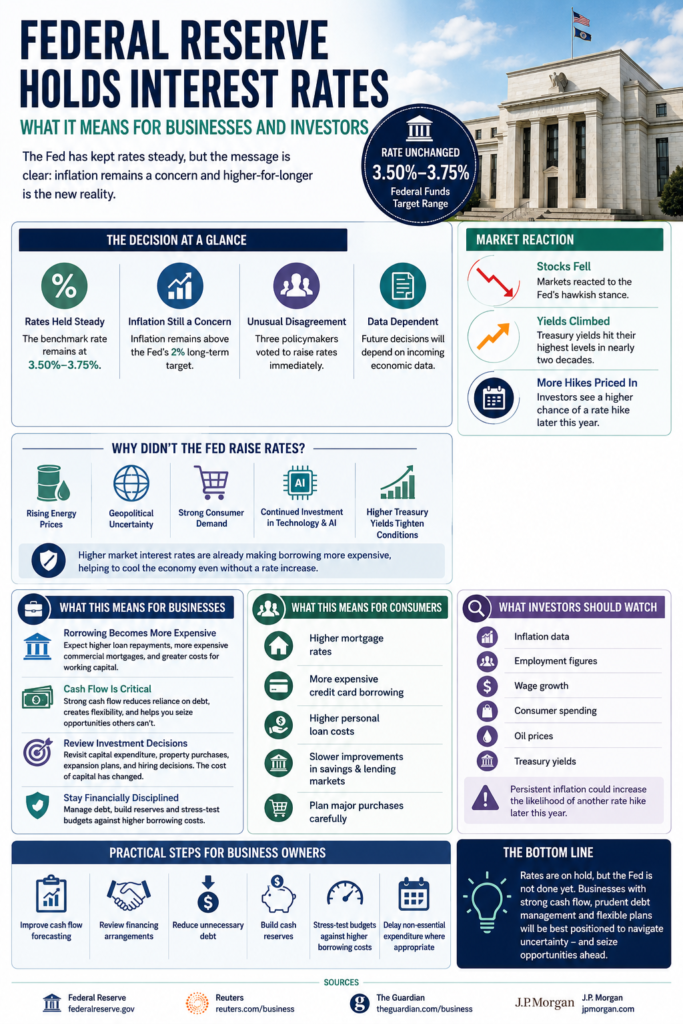
The Decision at a Glance
The Federal Open Market Committee (FOMC):
- Kept the benchmark interest rate at 3.50%–3.75%
- Signalled continued concern about persistent inflation
- Saw an unusually high level of disagreement among policymakers, with three members voting in favour of raising rates immediately
- Indicated that future decisions will remain heavily dependent on incoming economic data rather than predetermined guidance.
Rather than declaring victory over inflation, the Federal Reserve is effectively saying:
“We’re prepared to keep monetary policy restrictive for as long as necessary.”
Why Didn’t the Fed Raise Rates?
Although inflation has moderated from previous highs, it remains above the Federal Reserve’s long-term target of 2%.
Several factors continue to create inflationary pressure, including:
- Rising energy prices
- Ongoing geopolitical uncertainty
- Strong consumer demand
- Continued investment in AI and technology infrastructure
At the same time, longer-term Treasury yields have risen sharply, tightening financial conditions even without an official rate increase. Some economists argue that higher market interest rates are already doing part of the Fed’s job by making borrowing more expensive across the economy.
What This Means for Businesses
Higher-for-longer interest rates affect businesses in several ways.
Borrowing Becomes More Expensive
Businesses looking to finance expansion, purchase equipment, or refinance debt may face:
- Higher loan repayments
- More expensive commercial mortgages
- Increased financing costs for working capital
Companies relying heavily on borrowed money could see profit margins come under pressure.
Cash Flow Becomes Even More Important
Periods of elevated interest rates reward businesses with strong cash management.
Healthy cash flow allows companies to:
- Reduce dependence on expensive borrowing
- Invest when competitors cannot
- Take advantage of acquisition opportunities
- Weather economic uncertainty
Businesses with weak cash reserves may find themselves paying significantly more in financing costs over the coming months.
Investment Decisions Need Greater Scrutiny
Projects that appeared profitable when borrowing costs were low may no longer generate acceptable returns.
Business owners should revisit:
- Capital expenditure plans
- Property purchases
- Expansion projects
- Hiring decisions
The cost of capital has fundamentally changed.
What Does This Mean for Consumers?
Consumers may continue to experience:
- Higher mortgage rates
- More expensive credit card borrowing
- Increased personal loan costs
- Slower improvements in savings and lending markets
Anyone planning major purchases should factor higher financing costs into their budgets.
What Investors Should Watch
Markets are now focusing less on today’s decision and more on what happens next.
Key indicators include:
- Inflation data
- Employment figures
- Wage growth
- Consumer spending
- Oil prices
- Treasury yields
Any evidence that inflation is becoming entrenched again could increase the likelihood of another rate increase later this year.
Practical Steps for Business Owners
Regardless of whether rates rise again, now is a good time to strengthen your financial position.
Consider:
- Improving cash flow forecasting
- Reviewing financing arrangements
- Reducing unnecessary debt
- Building cash reserves
- Stress-testing budgets against higher borrowing costs
- Delaying non-essential expenditure where appropriate
Businesses that actively manage their finances are generally better positioned to navigate periods of economic uncertainty.
The Bottom Line
While the Federal Reserve left interest rates unchanged, the overall message was clear: inflation remains a concern, and policymakers are not yet ready to declare the tightening cycle over.
For businesses, this means preparing for an environment where borrowing costs remain elevated and financial discipline becomes increasingly important.
Companies with strong cash flow, prudent debt management, and flexible financial planning are likely to be in the best position to withstand continued uncertainty—and potentially seize opportunities as competitors struggle with higher financing costs.