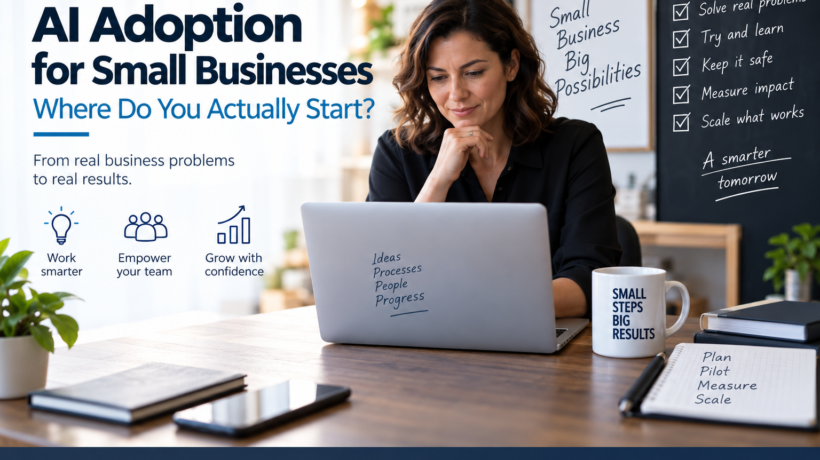
AI Adoption for Small Businesses: Where Do You Actually Start?
Artificial intelligence (AI) is becoming part of everyday business software.
Small businesses can now use AI to draft content, analyze information, answer customer questions, process documents, support sales teams, automate administrative work, and assist employees with routine tasks.
However, access to AI does not mean that a business has an adoption strategy.
A common mistake is to start with the technology.
A business sees a new tool and asks:
“How can we use this?”
Start with a different question:
“What business problem are we trying to solve?”
This change is important.
Good AI adoption does not start with a tool. It starts with a business problem. The business then identifies a suitable use case, selects the technology, tests it, applies controls, measures the result, and expands it only when there is evidence that it works.
A practical adoption framework is:
Business problem → Use case → Tool → Pilot → Controls → Measurement → Scale
This framework can help a small business introduce AI without creating an expensive technology programme.

1. Start With the Business Problem
Do not start by buying software.
First, identify work that causes a measurable business problem.
Look for activities that are:
- repetitive;
- slow;
- expensive;
- dependent on manual processing;
- difficult to scale;
- prone to human error;
- creating delays for customers; or
- taking employees away from higher-value work.
For example, a small professional services business might receive many customer enquiries each week. Employees manually read each enquiry, identify the subject, find the correct information, and prepare a response.
The problem is not:
“We do not have an AI chat bot.”
The problem could be:
“Our employees spend 15 hours each week answering repetitive customer questions.”
That statement gives the business something that it can investigate and measure.
Before you consider a technology solution, define the current process.
Ask:
What happens today?
How much time does it take?
How much does it cost?
Where do errors occur?
What effect does the problem have on customers or employees?
You need this baseline later. Without it, you cannot determine whether the new solution improved the process.
2. Turn the Problem Into an AI Use Case
The next step is to identify where AI could help.
Do not try to automate the complete business process immediately.
Select a specific task.
For example:
Business problem: Employees spend too much time answering repetitive customer questions.
Possible use case: Use an assistant to prepare draft responses from approved company information.
The employee reviews the response before it goes to the customer.
This is different from giving a system complete control of customer communication.
The first approach is an assisted process. The second approach is more autonomous and can create more risk.
Small businesses should usually start with narrow use cases where people can review important outputs.
Other examples include:
| Business problem | Possible AI use case |
|---|---|
| Too much time spent writing meeting notes | Generate meeting summaries and action items |
| Slow response to sales enquiries | Draft responses and identify customer requirements |
| Large number of incoming documents | Extract information from invoices, forms, or contracts |
| Repetitive marketing work | Produce first drafts of campaign content |
| Difficult internal knowledge search | Answer questions from approved company documents |
| Manual analysis of customer feedback | Group comments and identify common themes |
| Long sales calls that require manual updates | Summarise calls and prepare CRM updates |
| Repetitive administrative tasks | Classify requests and prepare the next action |
The objective is not to find the most impressive application.
Find a useful application that solves a defined problem.
3. Choose the Right AI Tool
Now evaluate the technology.
Many businesses reverse these steps. They purchase a product and then look for a reason to use it.
Avoid this approach.
Create a short list of requirements from the use case.
For example, if you want a system to help employees search company information, you might require it to:
- search approved internal documents;
- identify the source of an answer;
- respect user permissions;
- protect confidential information;
- work with your existing document platform;
- record important activity; and
- allow an employee to verify the answer.
Then compare available tools against these requirements.
Do not select a product only because it has the longest feature list.
Also consider integration, security, data handling, administration, support, cost, and ease of use.
Ask an important question:
Will this tool fit into the way our business already works?
If employees must move information manually between several systems, the new tool can create more work instead of less.
4. Run a Small AI Pilot
Do not deploy the system across the company immediately.
Run a controlled pilot.
Select:
- one use case;
- one process;
- a small number of users;
- a defined period; and
- clear success measures.
For example, a business could test a customer-service assistant with three employees for four weeks.
The system prepares draft responses. Employees review every response before it is sent.
During the pilot, record what happens.
Did employees save time?
Were the answers accurate?
Did employees have to rewrite most responses?
Did customers receive faster replies?
Did the system produce incorrect information?
Did employees actually use it?
These questions provide more useful information than the number of features in the product.
An AI pilot should produce evidence.
It should not exist only to demonstrate that the technology works.
5. Put the Right AI Controls in Place
New technology can create new risks.
A system can produce incorrect information. Employees can enter confidential information into an unsuitable service. An automated process can make a mistake at a much larger scale than a manual process.
Controls must therefore be part of AI adoption.
Do not add them only after a problem occurs.
For a small business, the first controls do not need to form a large governance programme. They must be clear and proportionate to the risk.
Define:
Approved tools. Employees must know which systems they can use for company work.
Approved data. Define what information employees can and cannot enter into external systems.
Human review. Identify outputs that a person must review before use.
Access. Give users only the access that they need.
Accountability. Assign an owner to each important use case.
Records. Keep appropriate records of important technology-assisted decisions and activities.
Escalation. Define what an employee must do when the system produces an incorrect, unsafe, or unexpected result.
Controls must match the use case.
Using AI to create ideas for a social media post does not have the same risk as using it to analyze financial information or communicate directly with customers.
Use stronger controls when the possible effect of an error is greater.
6. Measure the Business Results of AI
A pilot is not successful because the technology produced an answer.
It is successful when it improves a business outcome without creating unacceptable risk.
This distinction is important.
Return to the problem that you defined at the start.
If employees previously spent 15 hours each week answering repetitive questions, measure the new process.
For example:
Before: 15 employee hours each week.
After pilot: 9 employee hours each week.
Time saved: 6 hours each week.
Then examine quality.
If the system saves six hours but creates frequent incorrect responses, the business has not necessarily improved the process.
Use several measures where necessary.
These can include:
- time saved;
- cost per transaction;
- response time;
- error rate;
- employee adoption;
- customer satisfaction;
- conversion rate;
- work completed per employee; and
- percentage of outputs that require substantial correction.
The exact measures depend on the use case.
Define them before the pilot starts.
This prevents the business from changing the definition of success after it sees the results.
7. Scale AI When It Works
Not every pilot should become a permanent system.
A pilot can produce three valid decisions:
Stop. The use case does not provide enough value or creates too much risk.
Improve. The use case has value, but the process, data, instructions, integration, or controls need more work.
Scale. The use case produces measurable value and the controls operate correctly.
Stopping a weak use case is not a failed adoption programme.
It is a useful business decision.
If the pilot works, expand it gradually.
You could move from three users to one department. You could then extend the process to other suitable teams.
Do not assume that a successful use case in one department will automatically work in another department.
Measure each expansion.
Build an AI Use-Case Pipeline
After the first successful pilot, adoption should become a repeatable business process.
Create a simple register of potential use cases.
For each use case, record the business problem, expected benefit, process owner, data involved, risk, estimated cost, proposed capability, and success measures.
You can then compare opportunities before investing time and money.
For example:
| Use case | Business value | Risk | Effort | Action |
|---|---|---|---|---|
| Meeting summaries | Moderate | Low | Low | Pilot |
| Internal knowledge search | High | Moderate | Moderate | Assess |
| Customer email drafts | High | Moderate | Low | Pilot |
| Automated financial decisions | High | High | High | Detailed review |
| Marketing first drafts | Moderate | Low | Low | Pilot |
This creates a pipeline instead of a collection of unrelated experiments.
AI Does Not Mean Full Automation
AI adoption does not mean that technology must operate without people.
There is a progression.
AI assistance
The system helps a person complete a task.
Example: A tool drafts an email and the employee edits it.
↓
AI-supported workflow
The technology completes part of a business process.
Example: A system reads an enquiry, identifies its subject, and prepares a response for approval.
↓
AI automation
The system completes defined tasks automatically within established rules.
Example: The system classifies low-risk requests and routes them automatically.
↓
Agentic workflow
An agent can plan and perform multiple actions across business systems within defined permissions.
Example: An agent receives a sales enquiry, retrieves relevant product information, updates the CRM, prepares a follow-up, and creates tasks for the salesperson.
Each stage can increase the potential business benefit.
It can also increase the need for governance, monitoring, permissions, and controls.
You do not have to start at the final stage.
A Practical AI Adoption Framework for Small Businesses
The complete process can remain simple:
1. Business Problem
Identify a specific operational or commercial problem.
Measure the current process.
↓
2. Use Case
Define one task where the technology could improve the process.
Keep the initial scope narrow.
↓
3. Tool
Select a solution that meets the business, integration, data, and security requirements.
↓
4. Pilot
Test with a small group and for a defined period.
Do not deploy across the business immediately.
↓
5. Controls
Define data rules, permissions, human review, accountability, and escalation.
↓
6. Measurement
Compare the pilot with the original baseline.
Measure value and quality.
↓
7. Scale
Expand only when there is evidence that the use case works and the controls are effective.
Start With Purpose, Then Use AI
Small businesses do not need a large transformation programme before they can benefit from AI.
They need a clear problem.
A useful first project might save five hours each week. It might reduce customer response times. It might make company knowledge easier to find. It might remove repetitive administration from a small team.
That is enough to start.
The important point is to make adoption deliberate.
Do not begin with:
“Which AI tool should we buy?”
Begin with:
“Which business problem should we solve?”
Then follow the process:
Business problem → Use case → Tool → Pilot → Controls → Measurement → Scale
This approach makes AI adoption easier to manage. It also gives the business a clear basis for deciding where the technology creates value and where it does not.
As the organization gains experience, it can move from isolated tools to connected workflows, automation, and AI agents.
But the principle remains the same.
Start with the business problem. Not the technology.